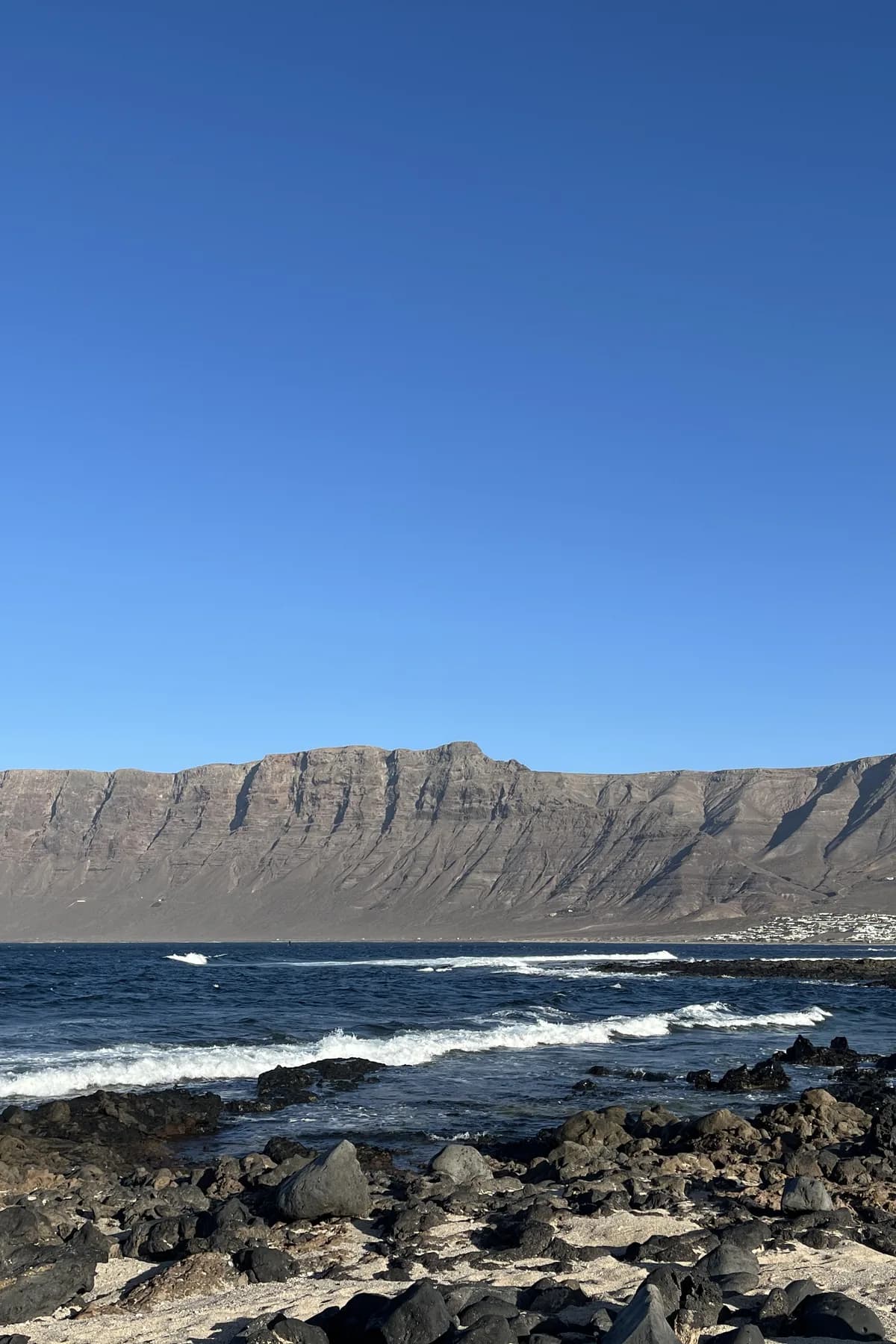
Lanzarote is, together with Fuerteventura, the oldest island in the Canaries: it has been out of the water for some fifteen million years. It was born from the ocean floor the way all the Canaries were — eruption by eruption — and it actually started out as two islands: one massif in the south (Los Ajaches) and another in the north (Famara), which later eruptions and a river of sand ended up stitching together. Its age explains its silhouette: millions of years of wind and waves have polished it low and elegant. And it keeps a family secret: when sea levels fell during the ice ages, Lanzarote and Fuerteventura were one single great island. Scientists call it Mahan.
All the Canaries are volcanoes born from the floor of the Atlantic, but they are not all the same age. The archipelago was built from east to west: the eastern islands are the veterans and the western ones the newcomers — El Hierro, the baby of the family, is barely past the million-year mark. Lanzarote emerged some fifteen million years ago, which makes it, with Fuerteventura, the dean of the archipelago. To put that in perspective: when this island was already sunbathing, our ancestors still had more than ten million years to go before climbing down from the trees.
Its biography has two protagonists. First to emerge was the edifice of Los Ajaches, the southern massif, whose rounded summits look down today on the beaches of Papagayo: they are the oldest rocks on the island. Later, further north, grew the Famara massif, the great rampart that now faces La Graciosa. For a long time they were two separate islands; later eruptions gradually filled in the gap between them, and the sand corridor of El Jable finished building the bridge. Lanzarote is, literally, two islands married by volcanoes.
Age explains its looks. A young volcanic island is tall and abrupt — Teide tops 3,700 metres. A veteran island has had millions of years of wind, rain and waves working against it: the edifices crumble, the ravines open up, the cliffs retreat. Lanzarote's highest point, the Peñas del Chache, stops at 671 metres. That short stature will have enormous consequences in another chapter: it is the reason so little rain falls.
And then there is the family secret. During the ice ages, with half the planet frozen, sea level dropped by more than a hundred metres. The narrow channel of La Bocaina, which separates Lanzarote from Fuerteventura, ran dry: the two islands and their islets formed one enormous single island, which scientists call Mahan. Plants and animals crossed on foot, and all that shared time explains why the two sisters have so many exclusive species in common today — the Atlantic lizard, the Canarian shrew, the houbara.
The story, by the way, is not over. The eruptions of 1730 and 1824 added the most recent chapter, and the whole archipelago is still alive — in 2021 a new volcano was born on La Palma. Lanzarote is a veteran, not a pensioner: fifteen million years and counting.