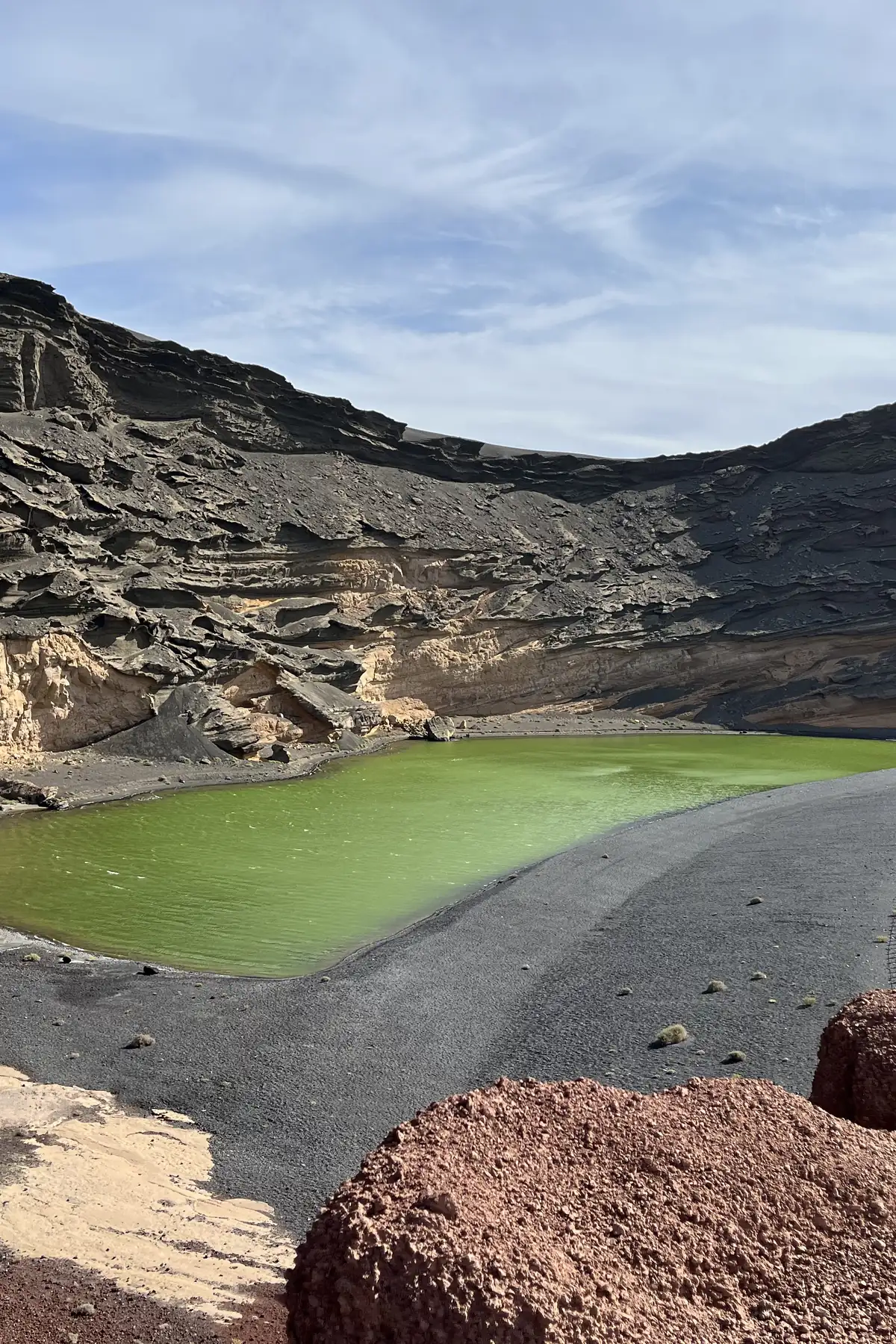
At El Golfo, the ocean ate half a volcano — and what it left behind is one of the island's most famous images: an amphitheatre of golden walls and, at its feet, a lagoon of an impossible green separated from the sea by a black beach. The colour is no filter: it is made by microalgae adapted to extremely salty water. In the sand glint green crystals of olivine, the volcano's gemstone. And a few kilometres south, at Los Hervideros, the coast proves the battle goes on: the waves come roaring into lava caves and explode in columns of spray. It is the corner where the island's eternal duel can best be watched: fire against ocean.
This south-western corner concentrates, in three consecutive stops, a masterclass in what happens when fire and sea fight each other for centuries.
First stop: El Golfo. There was once a volcano here that made a tactical error — being born too close to the water. When rising magma meets seawater, the eruption turns extraordinarily explosive: steam expanding violently, ash and fragments blasted out in surges. That is how this cone was built, layer upon layer, out of that golden, stratified rock you see today sculpted by the wind into cathedral shapes. Then the surf did the rest: century after century it bit into the edifice until it carried off a full half. What remains is an amphitheatre open to the Atlantic — half a volcano in cross-section, its innards on display, like a textbook diagram at full scale.
At the bottom of the amphitheatre waits the star: the Charco de los Clicos, also called the Lago Verde (Green Lake). It is seawater, filtered through and trapped behind a barrier of black sand, so concentrated in salts that almost nothing can live in it. Almost. Specialised microalgae thrive there in their millions and dye the water that intense emerald green, which shifts in tone with the season and the light. The contrast is unreal: ochre cliff, black sand, green lagoon, blue ocean — four pure colours in a single frame. The charco is a protected zone: you admire it from the viewpoints, without going down to the shore or bathing. Its name, by the way, comes from the "clicos", a shellfish that was once abundant here and that the fishermen used to gather.
A geological bonus for sharp eyes: in the dark sands of the area, small green translucent crystals sometimes glint. It is olivine, a mineral that travels up in the magma from tens of kilometres down — the gem version is called peridot. Looking at them, photographing them, admiring them: yes. Taking them away: no. Every handful that leaves in a pocket is landscape that never comes back.
Last stop: Los Hervideros, a few kilometres south. Here the lavas of the 1730 eruptions reached the sea and froze into a labyrinth of cliffs, arches and caves. When a swell rolls in, the ocean forces its way into those galleries and the compressed air bursts out in explosions of spray that make the viewpoint tremble — the name says it all: the sea seems to boil. With heavy seas and sunset light it is a hypnotic, and free, spectacle.
Fire that builds, sea that destroys, life that makes the most of the result. The whole biography of Lanzarote, summed up in ten kilometres of coastline.