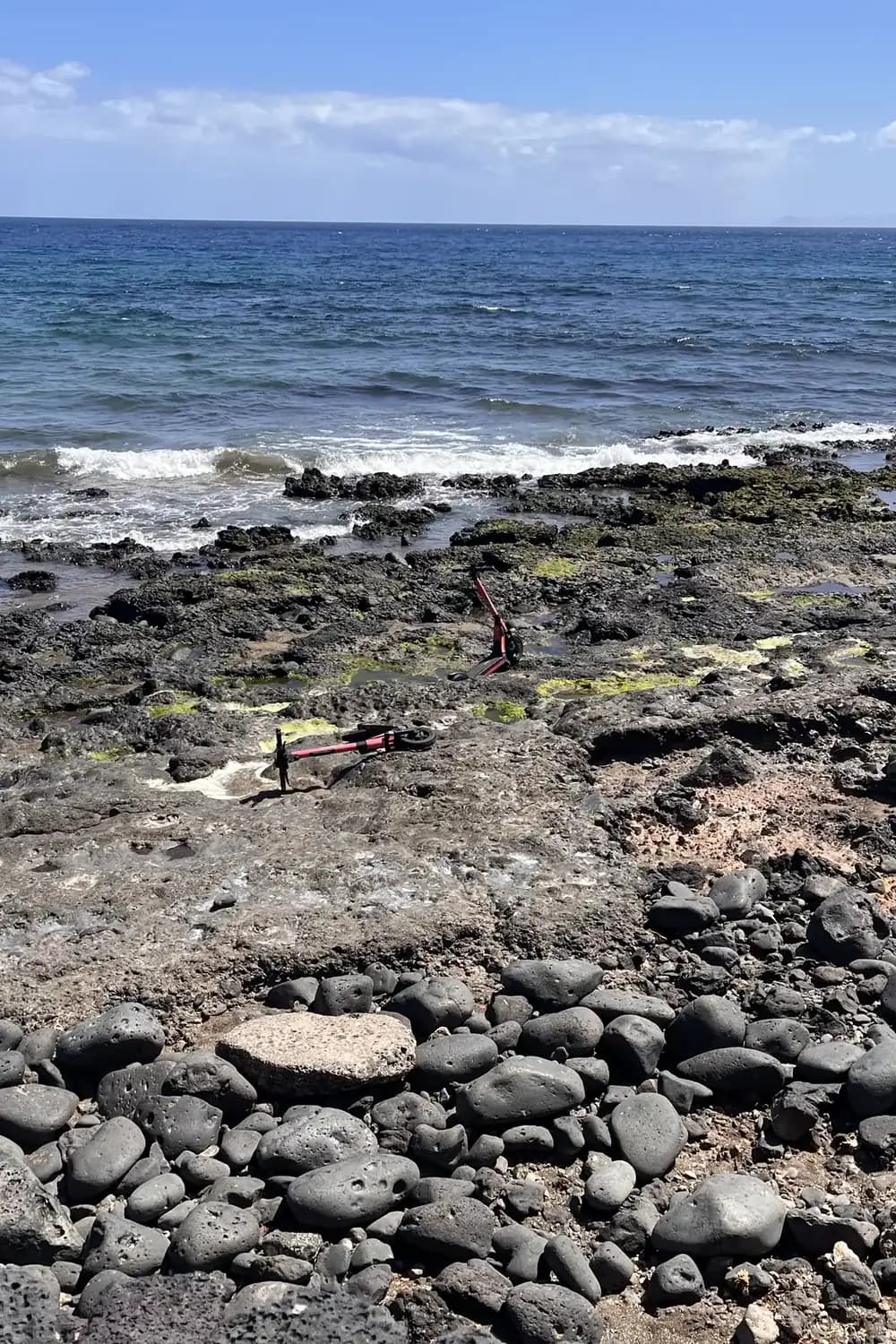
The Atlantic here rises and falls twice a day, with ranges that exceed two metres on spring tides — and knowing it changes your holiday. At low tide, Famara becomes an infinite mirror in which the cliff is reflected as in a lake; the rock pools of the north — the natural pools of Punta Mujeres or Los Charcones — are perfect for bathing; and strips of sand appear that didn't exist an hour earlier. At high tide, the small coves shrink and some coastal passages close. The local rule: consult the tide table (any app will do it) the way you consult the weather. The sea of this island is a clock — learn to read it and you will always arrive at the right time.
There is a show in Lanzarote that repeats punctually twice a day and charges no admission: the breathing of the ocean. The tides — that slow rise-and-fall the Moon and Sun cause by pulling at the planet's water — are discreet but decisive protagonists here: in the Canarian Atlantic, the difference between high and low water is around a metre and a half on ordinary tides and can exceed two and a half metres on spring tides, those of full moon and new moon, when Sun and Moon pull as a team.
Why should it matter to you on holiday? Because the island changes shape with the tide, and the same place can be two different experiences depending on the hour.
The supreme example is Famara. At high tide, a beautiful beach. At low tide, a phenomenon: the sea retreats hundreds of metres and leaves a plain of wet, polished sand in which the entire cliff is reflected as in a mirror — the most famous photograph of the island's north is taken there, in the two hours around low water. The rock pools of the northern shore play the same game: the natural pools of Punta Mujeres and Charco del Palo, or Los Charcones at Playa Blanca — those turquoise lagoons carved into the lava — are best enjoyed at mid or low tide, when the water lies still and transparent; at high tide with swell, the sea comes in over the top and the placid dip turns into a washing machine. It works the other way too: some sandy coves look their best at high tide, when the water covers the rocks at the shoreline.
The tide is also safety. Low water uncovers platforms of slippery rock and causes draining currents in bays and river mouths; high water can cut off the way back along the base of a cliff that could be rounded dry-shod an hour earlier — a classic precaution on stretches of wild coast. Shore anglers, shellfish gatherers (a regulated activity: limpets have their own rules, you don't collect without knowing them) and surfers live glued to the tide table; the smart visitor does too. It's easy: any marine weather app or a search for "tabla de mareas Arrecife" gives the day's times, which shift by about 50 minutes each day.
A bonus for the curious: the tide feeds two marvels of this collection. The lake of the Jameos del Agua rises and falls discreetly with it — the sea filters through the rock (card 01) — and the salt flats of Janubio (card 28) drink from the ocean thanks to that pulse. Even the Charco Verde at El Golfo renews itself by tidal filtration.
In short: the sea of Lanzarote keeps opening hours, and they are public. Half the island's finest moments — the mirror of Famara, the swim in Los Charcones, the long walk along the shore — are appointments with the tide. Put them in your diary.