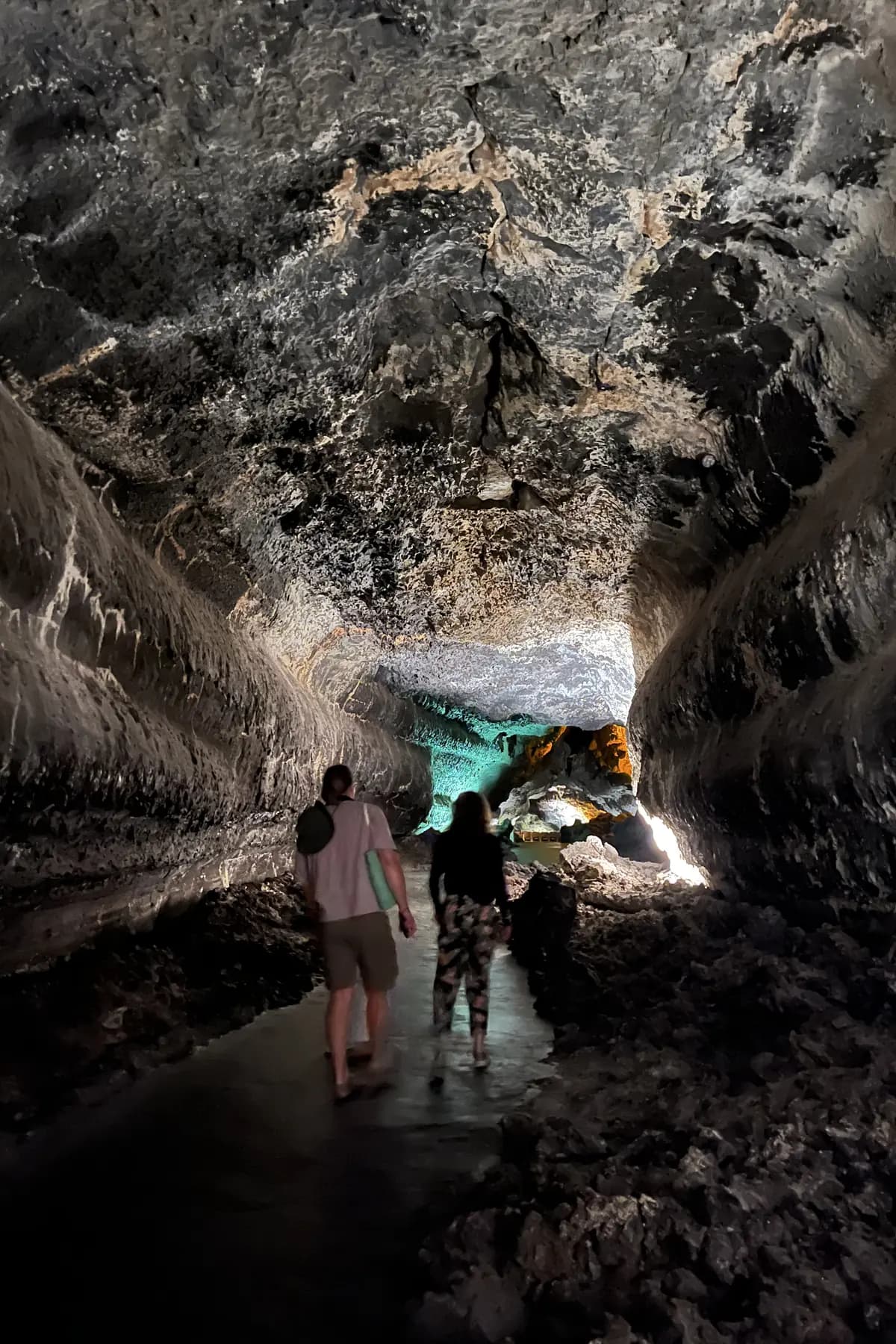
Beneath the north of Lanzarote, in a lava tunnel flooded by the sea, lives a community of animals that seems invented: worms that glow, transparent crustaceans and a blind predator — the remipede — belonging to a group so rare that science did not discover it until 1981. Several of these animals exist nowhere else on the planet: their home is, precisely, this tunnel. They live in total darkness, without plants, feeding on whatever the tide pushes inside twice a day. Biologists call this place "a window onto the deep ocean". You know it by its most famous doorway: the Jameos del Agua.
The Túnel de la Atlántida — the underwater continuation of the Cueva de los Verdes and the Jameos del Agua — is not just a geological record-holder. It is also one of the strangest ecosystems on the planet: a world of absolute darkness and crystal-clear salt water inhabited by a fauna that seems designed for a science-fiction film.
The scientific star is the remipede Morlockia ondinae, discovered here in the 1980s. The name is fair warning: it is dedicated to the Morlocks, the underground dwellers of H.G. Wells's "The Time Machine". It is an elongated crustacean, blind and unpigmented, which swims on its back rowing with dozens of identical legs. Remipedes are a group so archaic that until 1981 nobody knew they existed, and since then they have been found only in a handful of flooded caves around the planet — the Caribbean, Western Australia… and Lanzarote. They are also the only venomous crustaceans known: they inject their prey with a paralysing cocktail, like a snake in miniature. For a biologist, meeting a remipede is what discovering a new comet is for an astronomer.
It is not alone. Dozens of species have been catalogued in the tunnel's waters, and several are exclusive to this system: marine worms that have never seen the light, tiny paper-white crustaceans, and the celebrated jameíto, the little blind crab of the Jameos lake. Many belong to deep-water lineages: the most widely accepted theory is that the tunnel works as an embassy of the abyssal ocean — darkness, calm, stable water — where species from the depths found an extraordinary refuge a step from the surface.
What does this whole world live on, without sun and without plants? On the generosity of the tide. Twice a day, the sea pushes fresh water inside, laden with plankton and particles: a catering service that has been running for thousands of years. The tunnel's animals live in slow motion, with minimal metabolisms — down here, patience is a superpower.
All of which explains the strict rules of the Jameos: don't touch the water, don't throw anything in — a single coin rusting away is a toxic spill for this natural aquarium —, no flash. You are looking at an ecosystem unique in the world, as fragile as it is precious: the kind of place scientists from three continents study and that you can visit with a ticket. Few tunnels lead, literally, to another planet.