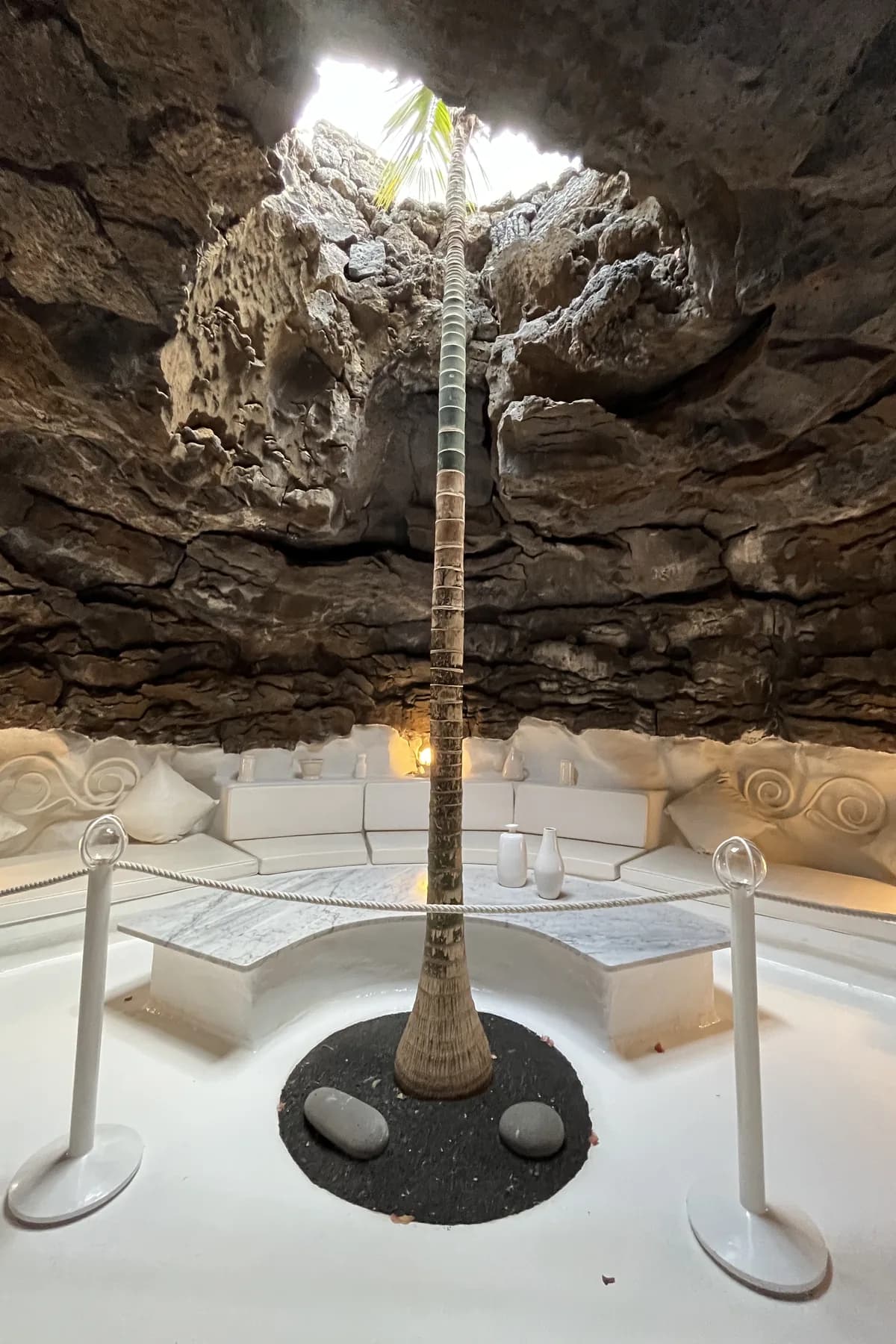
When the La Corona volcano erupted, some 21,000 years ago, its rivers of lava unwittingly produced a masterpiece: a tunnel of almost eight kilometres running through the north of the island. Sea level was far lower then; when the oceans rose, the final stretch was flooded — and today it is the Túnel de la Atlántida, the longest known underwater lava tube in the world: 1.6 kilometres of gallery beneath the Atlantic. The Cueva de los Verdes and the Jameos del Agua are the visitable doorways of this underground cathedral. Few places on the planet let you walk through the veins of a volcano — this is one of them.
A volcanic tube builds itself. During an eruption, the rivers of lava running down the slope cool from the outside first: the surface hardens and forms a roof, while inside the lava keeps flowing, hot and protected, like water through a pipe. When the eruption ends, the river drains away — and the mould remains: a cylindrical gallery with smooth, heat-polished walls, marks left by the level of the "current" and drips of frozen lava hanging from the ceiling.
The La Corona volcano, at the far north of the island, did this on a grand scale some 21,000 years ago, according to the most widely cited datings. Its main tube runs almost eight kilometres from the skirts of the cone to the coast at Órzola — one of the greatest volcanic galleries on the planet. At several points the roof collapsed over the centuries, opening natural windows known here as jameos. Those collapses are today the entrance doors: the Cueva de los Verdes, fitted out with masterly lighting, and the Jameos del Agua, which César Manrique transformed into the symbol of the island.
But the most astonishing chapter lies beneath the sea. When La Corona erupted, the planet was living through an ice age and the level of the ocean was tens of metres below today's: the coast lay far off, and the lava kept running beyond today's shoreline. When the ice melted and the seas rose, that final stretch was submerged just as it was, without collapsing. It is the Túnel de la Atlántida: 1,600 metres of gallery beneath the Atlantic, the longest underwater lava tube known in the world. Inside: total darkness, motionless salt water and a fauna from another planet that has a card of its own. Only scientific cave divers, with permits and extreme equipment, have reached its end — where the tunnel simply sinks into the sand at more than sixty metres' depth.
The whole complex is so exceptional that it forms the jewel of the UNESCO Global Geopark that recognises Lanzarote, and its candidacy for World Heritage status has even been proposed. European astronauts train in its galleries because identical tubes exist on the Moon and on Mars, candidates to become the first human bases.
Next time you are in the Cueva de los Verdes, switch off the tourist imagination for a second and switch on the geological one: you are inside the pipework of a volcano, built by a river of fire, preserved intact since before agriculture existed. And beneath your feet, beyond the shore, the gallery carries on in silence towards the bottom of the sea.