Lanzarote is what happens when nature is given fire, wind and time — and almost nothing else. With barely any rain and not a single permanent river, the island has turned scarcity into its greatest spectacle. In 1993, UNESCO declared the entire island a Biosphere Reserve, recognising something visitors feel within minutes of arriving: here, people learned to live with the land instead of against it.
The island's palette is unlike anywhere else in Europe. Around three hundred volcanic cones rise from plains of black and copper-coloured ash. In the north, the Famara cliffs fall dramatically towards the ocean from a height of almost six hundred metres, wrapped in trade-wind mist that feeds tiny plants growing nowhere else on Earth. In the south, the Janubio salt flats spread out in shining white squares, still harvested by hand as they have been for generations.
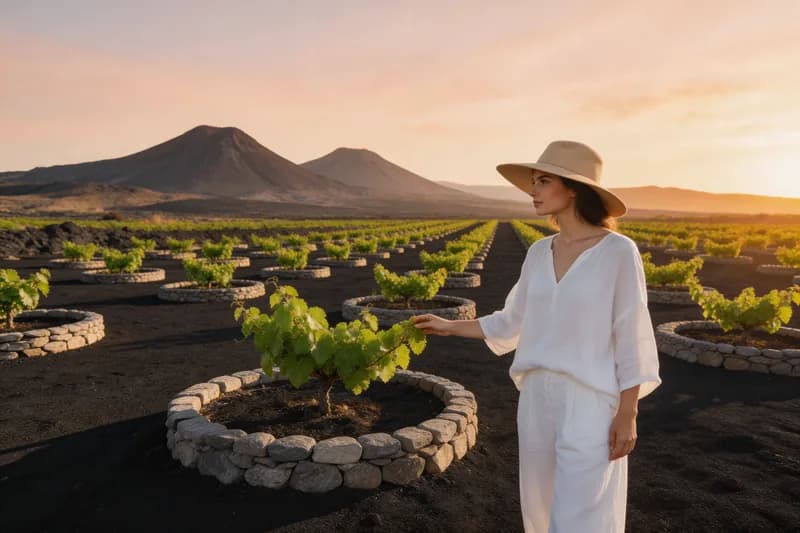
Perhaps the most moving landscape is La Geria, the island's vineyard country. After the great eruptions of the 1730s buried some of Lanzarote's best farmland, farmers refused to leave. They dug thousands of funnel-shaped hollows into the volcanic gravel, planted a single vine at the bottom of each one, and protected it with a low semicircular stone wall. The result is one of the most extraordinary agricultural landscapes in the world — and a white Malvasía wine that tastes of the volcano itself.
Nature here rewards slow attention. The Haría valley in the north shelters thousands of Canary palms, a green surprise in an island of ash. At El Golfo, a half-drowned volcanic crater holds a lagoon of an almost unreal green, separated from the blue Atlantic by a beach of black sand. And when night falls, Lanzarote's clear, dry skies — protected from light pollution — fill with more stars than most visitors have ever seen.
The island's greatest lesson is restraint. Buildings stay low and white. Roads curve around volcanoes rather than through them. Whole stretches of coast remain wild. Lanzarote proves that a small island, treated with respect, can feel immense.