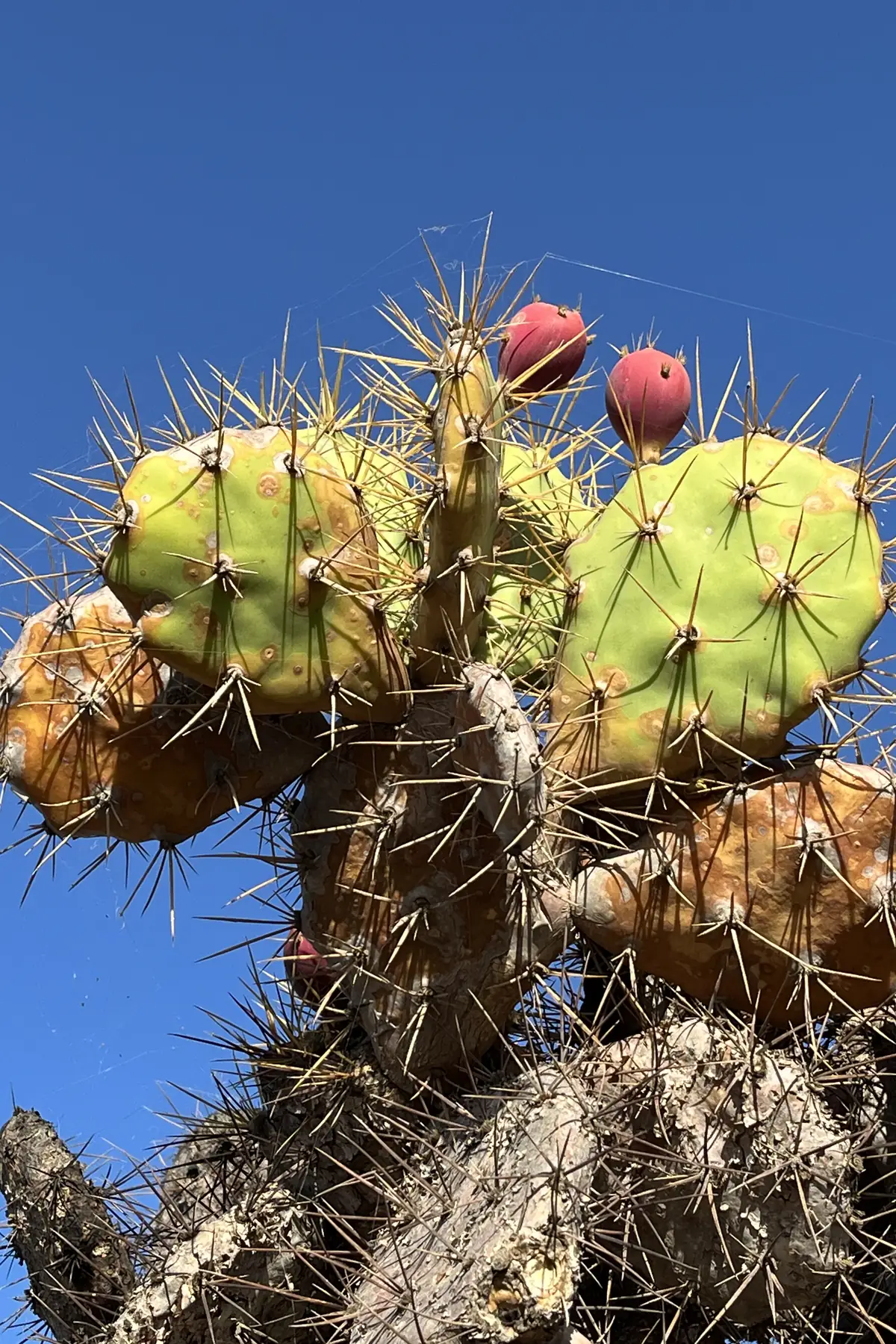
Those prickly-pear plantations around Guatiza and Mala are not decorative: they are a colour factory. On their pads lives the cochineal, a tiny insect which, dried and ground, produces carmine — one of the most intense and valuable reds in history. In the 19th century, this little bug made whole families rich: the island exported tonnes of "grana" to dye the uniforms, the silks and even the lips of half of Europe. Synthetic dyes sank the business, but Lanzarote never stopped harvesting it: today it is one of the few places in Europe where it is still produced, with a designation of origin of its own. And yes — carmine is still in lipsticks and foods. Check the label: E-120.
The story of the perfect red begins in America: the Aztecs were already rearing an insect on their nopal cacti to obtain a crimson dye that did not exist in Europe. When the Spaniards brought it to the old continent, "grana cochinilla" became red gold: it dyed the uniforms of armies, the robes of cardinals and the dresses of royalty. For centuries its production was almost an American monopoly — until, in the 19th century, someone thought of the Canaries: the same dry climate, the same happy prickly pears, and a workforce in urgent need of a new crop after the crisis of other products.
The experiment was a resounding success, and in Lanzarote it found its capital in the villages of Guatiza and Mala, in the north-east. The fields filled with tuneras (prickly pears) planted in grids on the picón (volcanic gravel), and on their pads the cochineal was "sown" — by hand, with a goldsmith's patience. The insect is a minuscule capsule, silvery grey, that lives glued to the plant sucking its sap; the females concentrate carminic acid, the pigment, inside their bodies. The harvest was — and still is — pure craftsmanship: the pads are scraped one by one, the insect is dried in the sun and the result is the grana: it takes tens of thousands of cochineals to make a single kilo. By the mid-19th century, that crimson powder was one of the islands' great export products and built the stately houses that can still be seen around the area.
The end of the tale was written by chemistry: synthetic dyes, cheap and industrial, sank the market within a few decades. Many fields were abandoned… but Guatiza and Mala never quite let go of their insect. And time proved them right twice over. First, because natural carmine came back into favour: it is the colouring E-120, present in high-end cosmetics, food and drink, and the artisan Canarian producers now have the backing of a Protected Designation of Origin — the cochineal of these islands is a product with an official surname. Second, because that sea of prickly pears became a cultural landscape: César Manrique chose precisely an old rofera (ash quarry) in Guatiza for his last great work, the Jardín de Cactus, an explicit homage to the world of the tuneras that surrounds it.
So the next time you pass through the north-east, look at those fields bristling with green pads through different eyes: you are looking at a living 19th-century industry, an insect that dressed kings, and the red — authentic, organic and island-made — that you may be wearing on your lips right now.