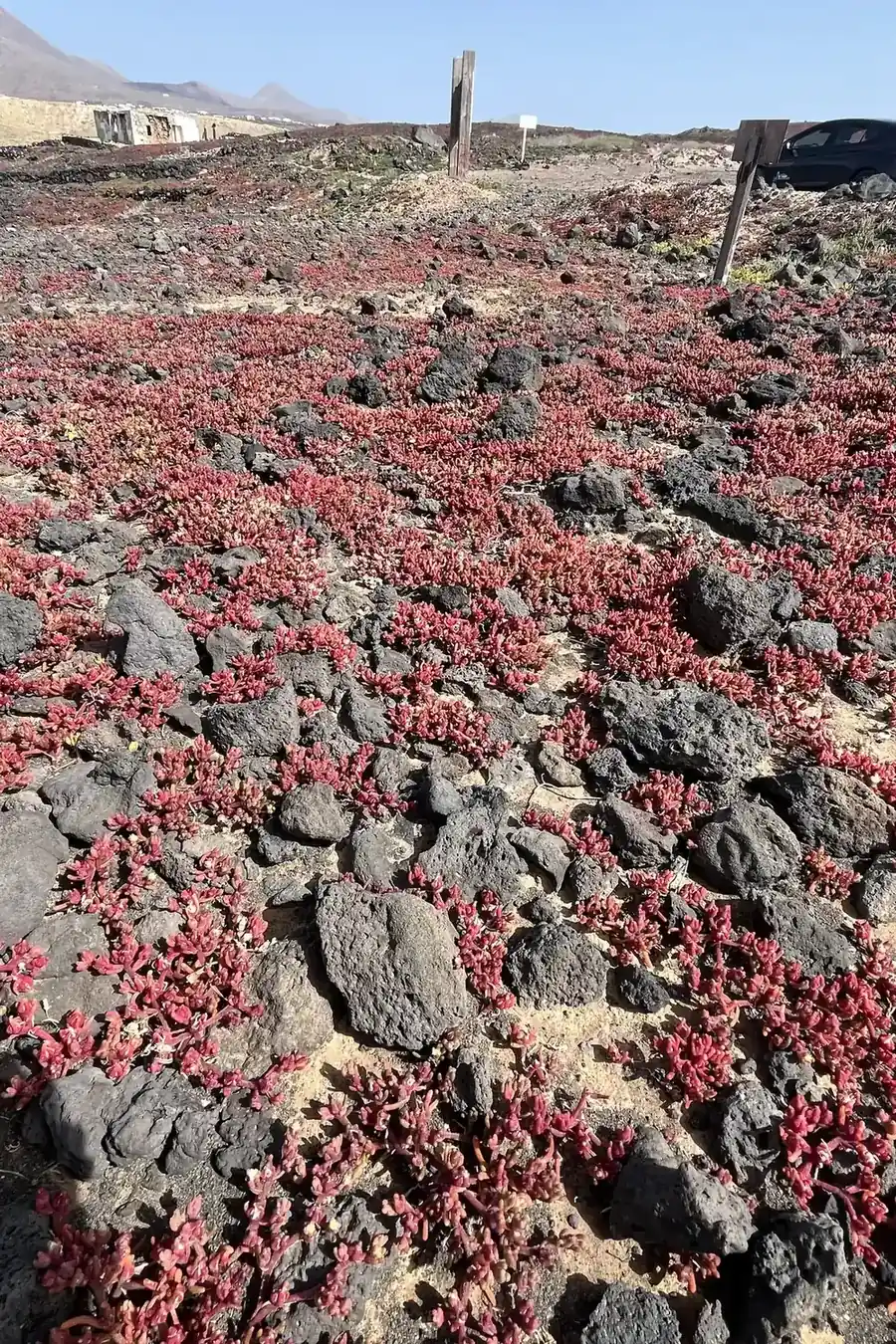
Look closely at the "dead" lava of Timanfaya and you'll see it's painted: grey, green and orange patches cover the rock like frost. They are lichens — the first colonists of any new world. They arrive on the wind, cling to the bare stone and, over centuries, slowly turn it into soil. Behind them comes the tabaiba, a small twisted tree the islanders used to chew like gum. Lanzarote is one of the best places on the planet to watch this process live: almost three hundred years after the eruptions, life is still conquering the lava centimetre by centimetre. Scientists study it here to understand how life began on Earth — and how it might begin on Mars.
When lava cools, nothing remains: no soil, no seeds, no shade. A desert of brand-new rock. What happens next is one of nature's slowest and most beautiful stories, and Lanzarote is its finest stage: here you can walk beside lava flows nearly three centuries old and watch, live, the first chapter of life.
The opening protagonists are the lichens: alliances between a fungus and an alga that work as a single organism. They need no soil — rock, light and the moisture that the trade winds (los alisios) and the sea mist leave overnight are enough. The first to arrive is usually a silvery-grey lichen that covers the lavas like pale ash; over the years orange, yellow, green and black species join in, until the malpaís (badlands lava) becomes a painting done at geological speed. In Timanfaya and its surroundings close to two hundred species have been catalogued — an exceptional diversity that makes these flows a natural laboratory.
The lichens' work is twofold: their acids gradually break down the surface of the rock, and their remains, together with the dust the wind traps, gather in the cracks and bubbles of the lava. There, in those handfuls of "proto-soil", the first true plants germinate. The queen is the sweet tabaiba: a little tree with a swollen trunk and wind-twisted branches, able to live on a miserable ration of rain. Its white sap, sweet and non-toxic, was the islanders' traditional chewing gum for generations. Alongside it settle aulagas (spiny gorse-like shrubs), bobos and verodes, and with them come insects, lizards, birds: the whole ecosystem, rebuilding itself on its own.
The fascinating part is the timetable. The lava flows of 1730-1736 have been at this for almost three hundred years and are still, in many areas, in the lichen phase: that is how slowly a soil is born in a climate without rain. That's why the National Park forbids stepping off the paths — one footprint can erase decades of microscopic work — and why scientists, including those preparing space missions, come to study these lavas: they are the closest thing there is to the surface of a young Mars, and lichens are serious candidates for explaining how life can take hold of a planet of stone.
Next time you walk beside the malpaís, crouch down for a moment. That "stain" on the rock is a three-hundred-year-old pioneer working in silence so that, a thousand years from now, a garden can grow there.