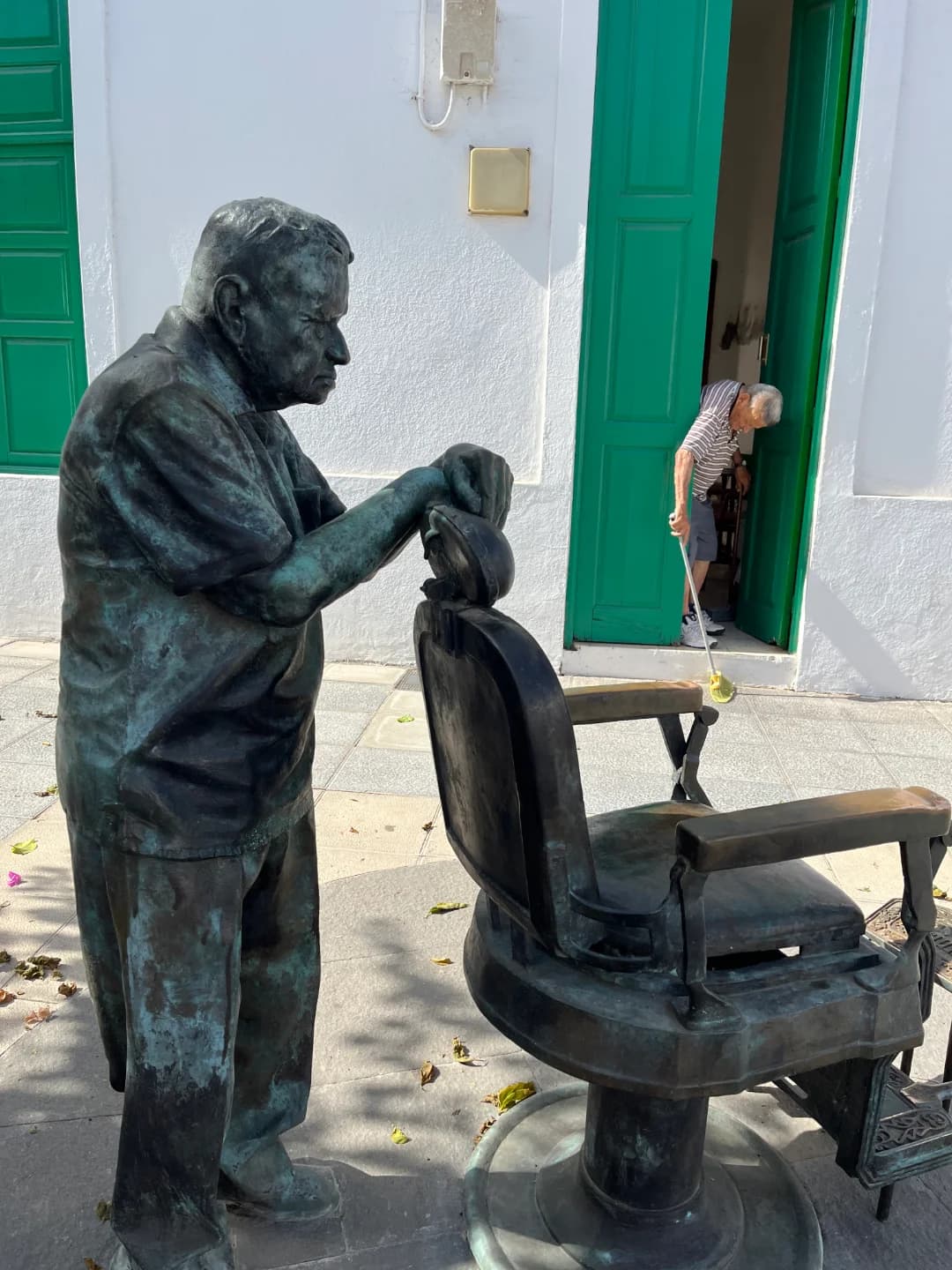
Three island lives to boast about. Blas Cabrera, born in Arrecife in 1878, was the father of Spanish physics: a world authority on magnetism, he took part in the mythical Solvay conferences alongside Einstein, Curie and Bohr — and Einstein visited him and praised his Madrid laboratory. Rosana Arbelo, from Arrecife, conquered the nineties with "El talismán" and still fills theatres with her guitar and her conejera smile. And Ladislao Rodríguez, "el mudo de Haría", a deaf barber whose barbershop was for decades the social heart of his village: in 2025 Haría dedicated a bronze statue to him — seated in his barber's chair, naturally. Genius, voice and goodness: three ways of being great while born on a small island.
Small islands produce big biographies, and Lanzarote has a surprisingly varied gallery of illustrious offspring. Here are three, chosen because they cover the whole spectrum: science, art, and that supreme category which is being a good person.
The first played in the league of giants. Blas Cabrera Felipe was born in Arrecife in 1878, the son of an island family, and ended up as the father of Spanish experimental physics. A professor in Madrid, a world reference in magnetism — his measurements of the magnetic properties of the elements were canonical for decades —, he directed the great laboratories of pre-war Spanish science and represented Spain at the Solvay conferences, the summits where a score of minds — Einstein, Marie Curie, Bohr, Schrödinger — redesigned reality. With Einstein he had a direct relationship: the German visited his laboratory in Madrid in 1923 and praised his work. The Civil War drove him into exile — he died in Mexico in 1945 — and for decades his name was unjustly dimmed. Today Spanish science is reclaiming him in style: prizes, institutes and conferences bear his name, and his island tells his story with pride — the boy from Arrecife who argued with Einstein.
The second put the island on every radio. Rosana Arbelo — Rosana, plain and simple — grew up in Arrecife in a large family and left the island with a guitar and a handful of songs. In 1996, her debut "Lunas rotas" swept the board: "El talismán" and "Sin miedo" played across half the planet, with millions of records sold and tours through Europe and the Americas. Thirty years on she is still going strong, with that mixture of hers of luminous poetry and rhythm — and she has never let go of her roots: her homecomings are an event, and in her interviews the island always appears as the source of her light. When "El talismán" comes on in some beach bar, now you know: that's local produce too.
The third never left his village — and that is why he is a legend. Ladislao Rodríguez Bonilla, "el mudo de Haría", was the village barber: deaf from birth, he turned his family barbershop into the true social centre of Haría — the place where everything was known, fixed and celebrated. A director of the local football club, a collaborator in every good cause, a silent helper to anyone who needed him, he received in his lifetime the affection of all and official honours — the Gold Medal of the Canaries in 2011, the municipal sports hall named after him. In March 2025, Haría unveiled in its square a bronze statue by the artist Rigoberto Camacho that portrays him as he should be: seated in his barber's chair, waiting for the next neighbour. Tourists photograph themselves with it without knowing who he is; now you do — and that is exactly the point of this card.
A genius of physics, a universal voice and a barber who was the soul of his village. Three ways of proving that the size of an island is not measured in kilometres.