In an underground lake in the north of the island lives an animal that exists nowhere else on the planet. It's called the jameíto (blind albino crab), it measures barely a centimetre, it's paper-white and completely blind. Its closest relatives live in the depths of the ocean, thousands of metres down; this one, though, lives just steps from the surface, in the crystal-clear waters of the Jameos del Agua. César Manrique turned it into the symbol of the place, and today it's practically the island's unofficial emblem. Seeing it is easy: hundreds of white dots glowing in the dark water. Protecting it is easy too: no coins, no flashes, no touching the water.
The jameíto (Munidopsis polymorpha) is, technically, a small blind squat lobster. It was first described by science at the end of the 19th century and has baffled biologists ever since: it belongs to a family of crustaceans that almost always lives on the abyssal plains, at enormous depths, in the total darkness of the ocean floor. And yet here it is, barely a few metres below sea level, in the inner lake of the Jameos del Agua.
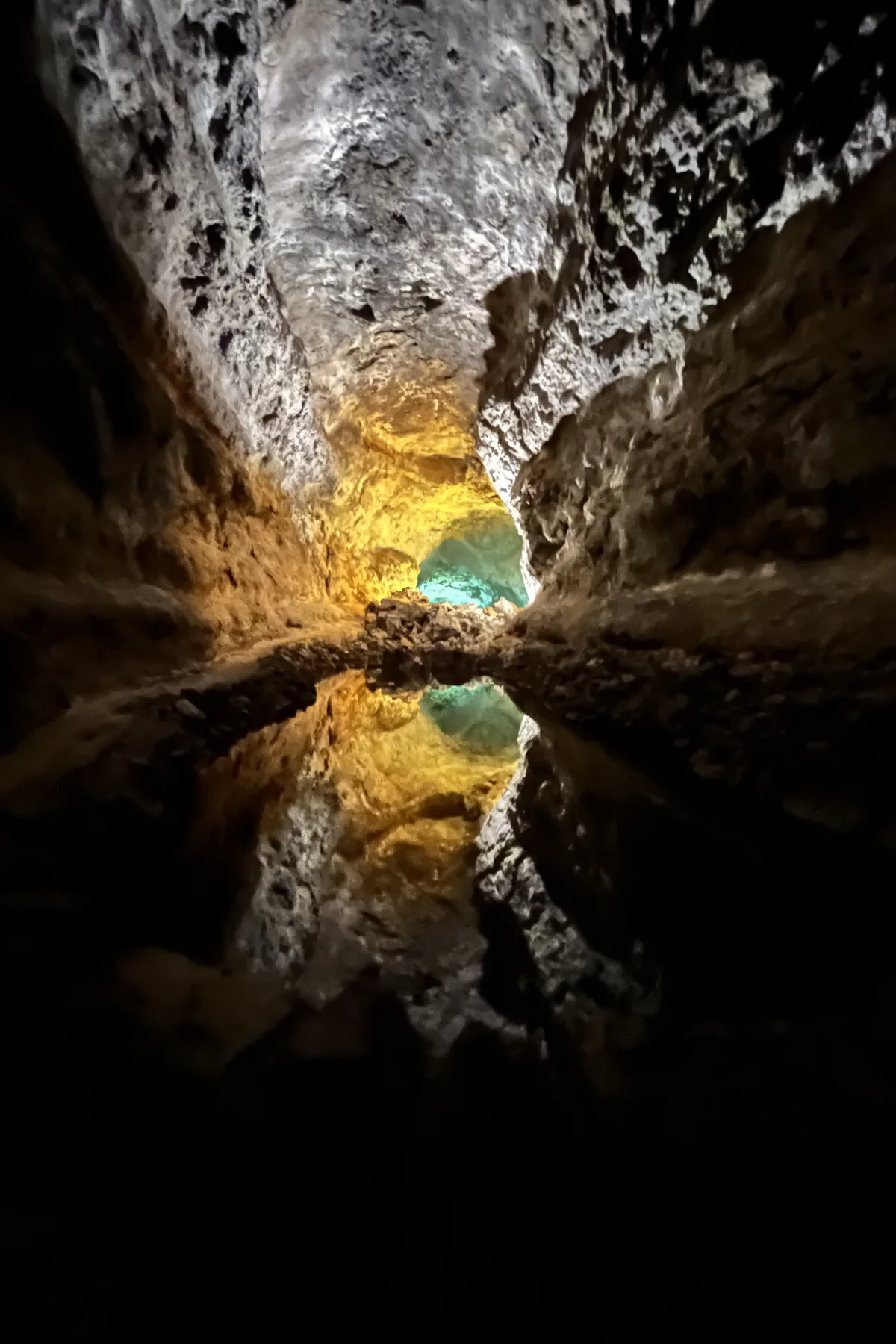
The explanation is the volcanic tunnel itself. When the La Corona volcano formed its enormous lava tube, part of it was flooded by seawater filtering through the rock. The result is an exceptionally rare habitat: salt water, still, transparent and in perpetual half-light — a slice of "deep sea" wedged inside an island. For the jameíto, that lake is the entire universe. There is no other population like it anywhere in the world.
Its body tells its story: no pigment, because in the dark colours are of no use; no working eyesight, because neither are eyes; and extremely long antennae it uses to "see" by touching and smelling the water. It feeds on the microscopic particles the tide pushes into the tube twice a day.
It is also a fragile animal. The copper in a single coin tossed into the lake oxidises and can poison entire colonies — which is why throwing anything into the water is strictly forbidden. Bright light and noise stress them too. When you visit the Jameos, watch it unhurriedly: hundreds of little white dots moving across the black rock, like stars in an inverted sky.
César Manrique understood before anyone else what he had in front of him: he turned the little crab into the logo of the Jameos del Agua, and its silhouette is now all over the island. Few places in the world can boast anything like it: an animal that exists only here, in a cave, and fits on a fingertip.