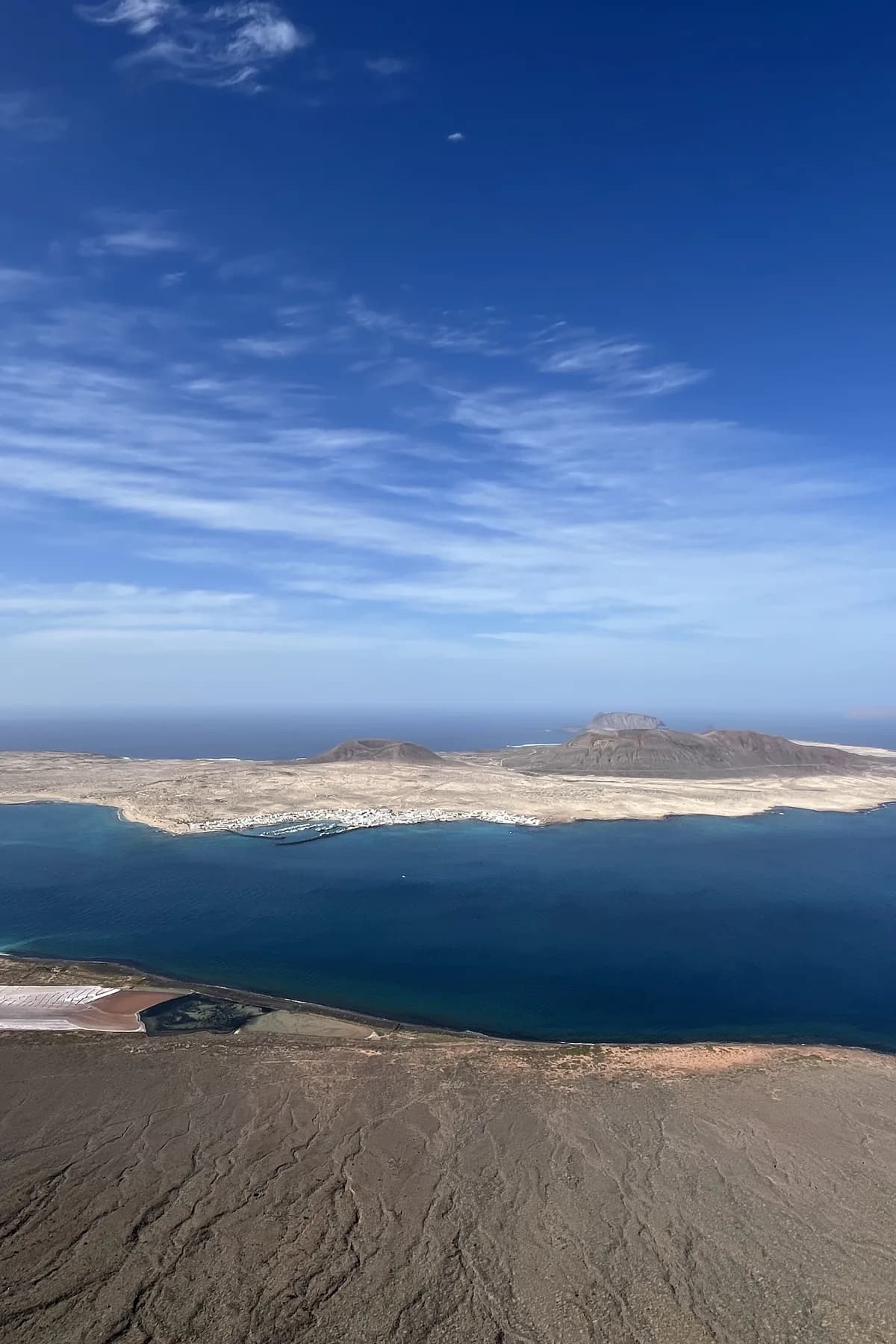
Half an hour by boat from Órzola there is an island where tarmac doesn't exist: the streets of La Graciosa are sand, the cars can be counted on your fingers and the rhythm is set by the tides. It is the eighth Canary island — officially recognised in 2018 —, home to some seven hundred residents who live in Caleta de Sebo, a picture-postcard white village facing the golden rampart of Famara. You explore it on foot or by bike, from virgin beach to virgin beach: Las Conchas, La Francesa, La Cocina. There are no big hotels, no traffic lights, no noise. There is ocean, gentle volcanoes and the feeling — so rare these days — of having arrived somewhere time behaved itself.
There is a thought experiment La Graciosa answers in real life: what would a Canary island be like if the 20th century had passed it by? Separated from Lanzarote by the strait of El Río — an arm of sea barely a kilometre wide beneath the cliffs of Famara —, this island of 29 square kilometres is the largest of the Chinijo Archipelago and the only inhabited one. For centuries it was a land of fishermen and little else; today it is a sanctuary of calm inside the largest marine reserve in Europe, and since 2018 it has held a title its residents celebrated like a World Cup: the Senate officially recognised it as the eighth Canary island, lifting it out of the small print of the maps.
Everything about it is on a human scale. Caleta de Sebo, its capital and almost its only village, is a handful of white houses with blue doors lined up facing the jetty; the streets are golden sand — there is not a single tarmacked road — and the "avenues" are crossed by barefoot children, bicycles and the odd neighbour on a pedalo on the way back from fishing. The second settlement, Pedro Barba, is a row of little holiday houses facing the sea, lived in only in season. The census hovers around seven hundred inhabitants; the number of authorised cars, a tiny handful of licensed 4x4s, nearly all of them sand taxis.
The perfect plan is simplicity itself. Ferry from Órzola — a half-hour crossing with the rampart of Famara as your escort, eyes peeled for shearwaters and flying fish —, a bike hired at the jetty or boots on, and a beach to choose. Las Conchas, in the north, is the diva: fair sand, turquoise water and the islet of Montaña Clara floating opposite like a stage set (serious currents: better contemplated than swum). La Francesa and La Cocina, in the south, are gentle coves of transparent water at the foot of the Agujas Grandes volcano. Between one and the next: sand tracks through golden scrub, silence, and that horizon of islets — Montaña Clara, Alegranza — that feels like the end of the known world.
Its fragility is the other face of its magic, and the island protects itself with clear rules: camping only in the authorised area with a permit, no private vehicles, rubbish back in your rucksack, marked paths. The ferry's capacity acts as a natural regulator — there will never be crowds on La Graciosa, and that is exactly the idea.
Go for a whole day or, better, stay a night: when the last ferry leaves, the island turns the volume down further still, the sky fills with real stars and you understand the privilege — you are on the last tarmac-free island in Spain, and tomorrow you'll eat breakfast listening to the sea.