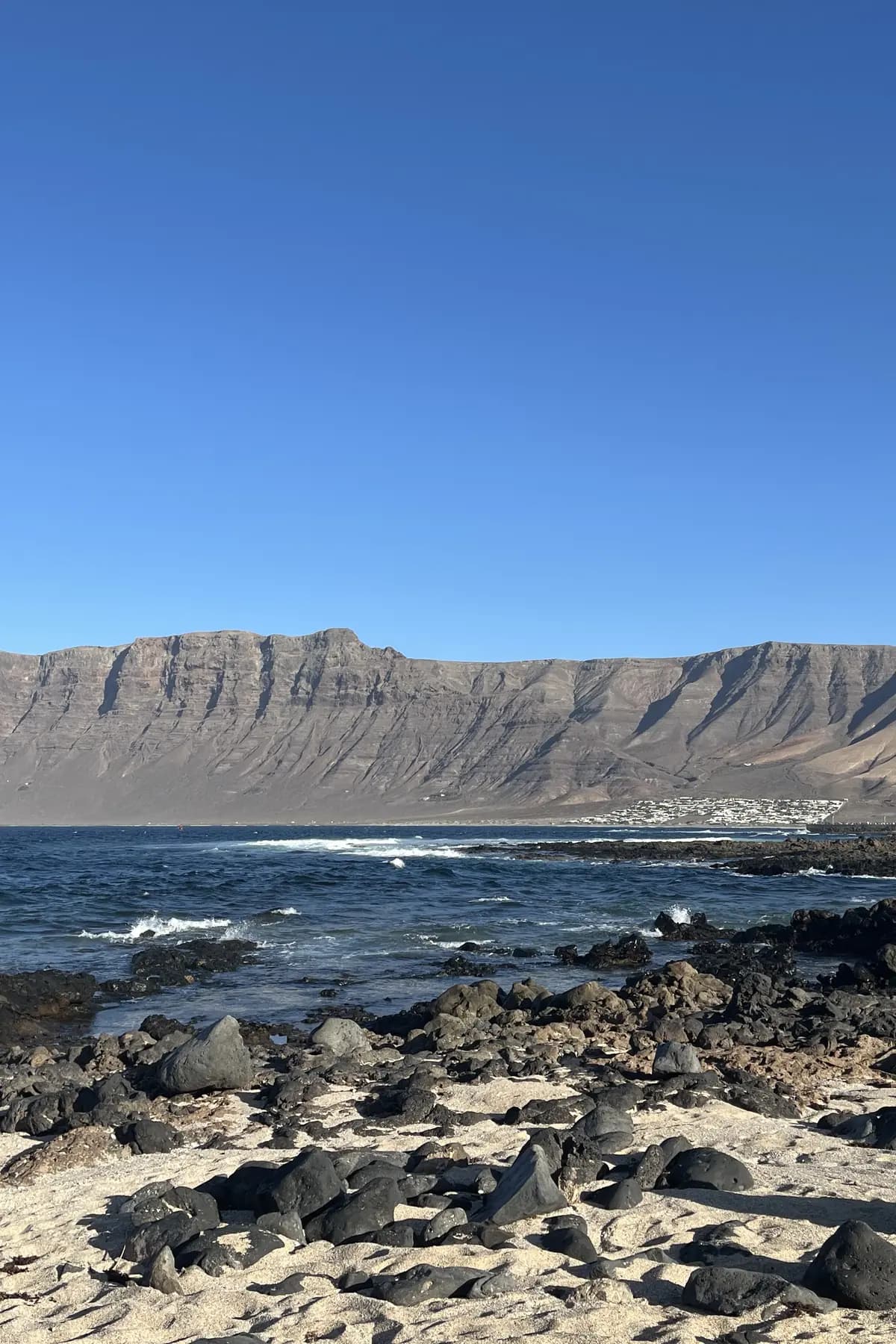
The Famara cliff is the island's highest rampart — and its secret botanical garden too. On its vertical ledges, where the goats never reached and the sea breeze leaves its dew each night, survive plants that grow nowhere else on the planet: more than a dozen exclusive species, with names that sound like treasure — the Famara everlasting (siempreviva de Famara), the cottony yesquera algodonera, the Lanzarote bejeque. Botanists from all over Europe make pilgrimages to this risco (cliff face) the way people visit a museum holding the only copy of each work. From the viewpoint, so can you: that 600-metre wall dropping to the sea is one of the best-kept natural jewels of the Canaries.
Every ancient massif keeps secrets, and Famara's — the oldest part of the north of the island — keeps the best ones. Its great cliff rises almost 600 metres above the ocean, facing La Graciosa, and works like a humidity-making machine: the trade winds (los alisios) collide with the wall, the sea air climbs and condenses, and the ledges of the risco receive an invisible watering of mist and dew that the rest of the island never sees. Add centuries of inaccessibility — no goats, no ploughs, no roads — and you have the recipe for a perfect botanical refuge.
The result is extraordinary: this corner concentrates the greatest plant diversity in Lanzarote, with hundreds of species, and among them more than a dozen that are exclusive — plants whose entire world population lives on this cliff and its surroundings. The Famara everlasting (siempreviva de Famara) opens its mauve paper flowers over the abyss. The cottony yesquera algodonera, wrapped in a white wool that shields it from sun and thirst, looks snow-dusted in the middle of August. The Lanzarote bejeque (a native houseleek) spreads its fleshy rosettes in the cracks, and the Lanzarote cañaheja (giant fennel) raises its yellow stalks, more than a metre tall, in spring.
Why does it matter so much? Because each of those species is an unrepeatable evolutionary experiment. Isolated on their rampart for thousands of years, they adapted millimetre by millimetre to this particular cliff, its particular mist, its particular wind. If they disappear from here, they disappear from the universe. That's why much of the risco is protected, and why botanists treat it like a treasure vault: you come here to look, not to pick.
The good news is that looking is easy and free. From the village of Famara, the whole rampart lights up ochre and gold at sunset. From above, the viewpoints of the north — including the celebrated Mirador del Río — hang you literally over the vertical garden. And the waymarked footpaths along the top of the risco let you lean into this world without treading on it.
Some islands boast rainforests. Lanzarote boasts something rarer: a hanging garden above the Atlantic where every flower is a survivor with a name of its own.