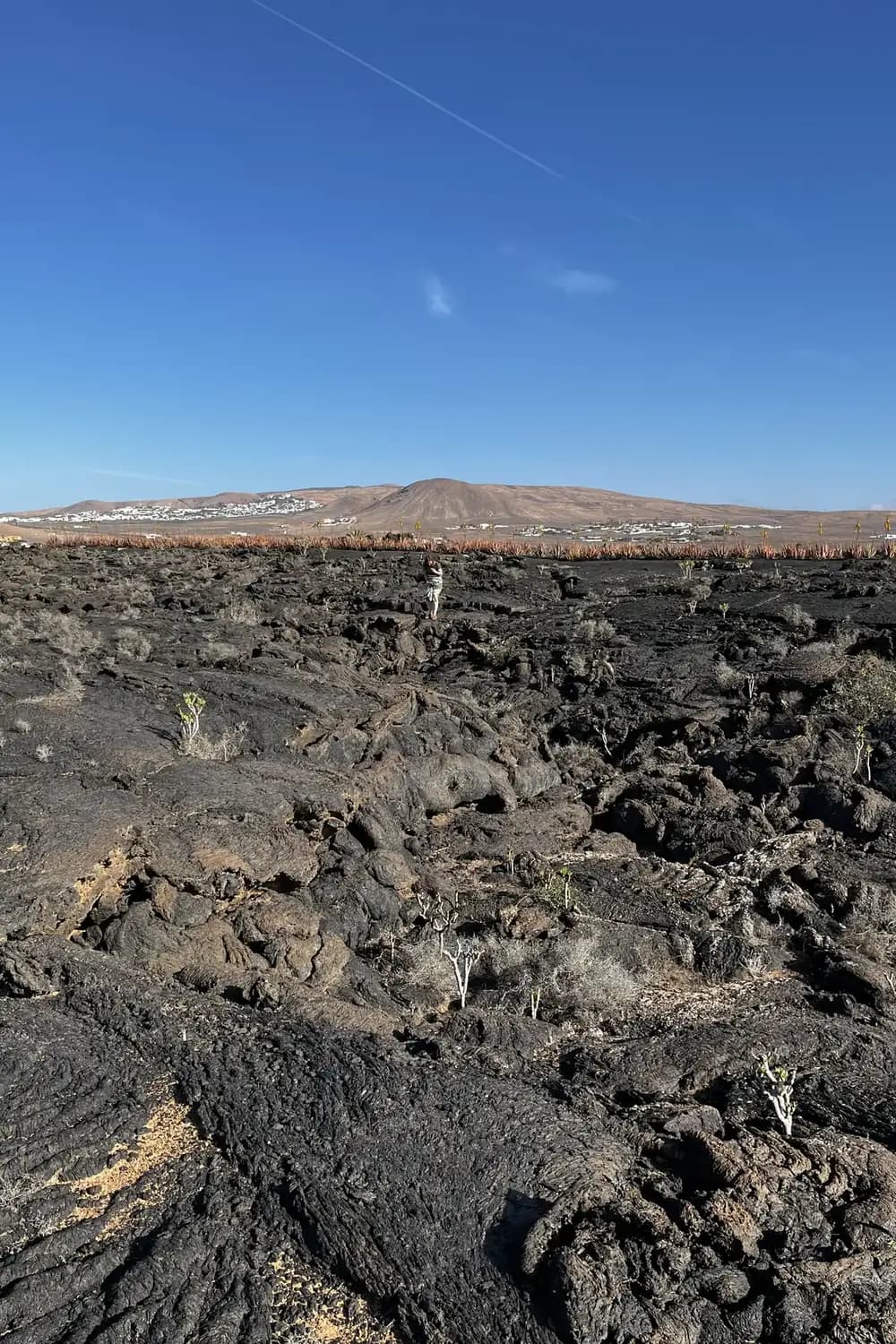
Lava is not all the same, and once you learn to tell it apart, the whole island turns into an open book. There is "spiky" lava — the malpaís (badlands lava), a chaos of sharp rocks the islanders named that way because it was good for nothing — and "ropy" lava — the lajial, smooth and rippled like melted chocolate that stopped moving. There are hornitos, goblin chimneys built from spatter; volcanic bombs shaped like rugby balls that flew spinning through the air; and picón (volcanic gravel), that black grit covering half the island, which made its agriculture possible. This card is your basic volcano dictionary: five words and suddenly the landscape speaks.
First lesson in island volcanology: lava has two temperaments, and in Lanzarote the two live side by side. When it advances hot, fluid and fast, it forms smooth, glossy surfaces with folds like ship's rope: that is the lajial (geologists call it pahoehoe lava, a Hawaiian word). Walking across a lajial is treading a sea of solidified chocolate — you can see the ripples, the eddies, even the frozen "splashes". When the lava advances colder, slower and stickier, its crust breaks again and again, and the result is the malpaís (aa lava): a chaos of sharp blocks, impossible to cross, that cuts through boots and patience alike. The name was coined by the farming folk, and it is honest: "bad country", land not fit even for goats. Today we know it is worth a very great deal — as habitat and as geological archive — but the word stuck, and from the Canaries it leapt into world volcanology.
Second lesson: the details. Hornitos are little chimneys of two or three metres built by the lava itself when, passing over moisture, it spits out blobs that weld themselves into a tower — they look like mud sculptures made by a giant in a hurry. Volcanic bombs are gobbets of lava launched in mid-flight: they spin through the air, taper at the ends and land shaped like a rugby ball or a spindle; they range from fist-sized to washing-machine-sized. And the flows hide tunnels: when the surface cools but the interior keeps flowing, the lava drains away like a tap and leaves a tube — that is how the Cueva de los Verdes and the Jameos were born.
Third lesson, the most islander of them all: the picón. Also called rofe or lapilli, it is that black, porous gravel the eruptions hurled out in astronomical quantities and which today covers entire fields. Each little stone is a droplet of lava full of gas bubbles — which is why it weighs so little and why it is a sponge: at night it condenses the dew and delivers it slowly to the earth beneath. The farmers turned that property into a farming system unique in the world, the enarenados, which have a card of their own.
With this dictionary, any stroll changes. That broken plain along the road: malpaís. That corded surface beside the footpath: lajial. The solitary little tower: hornito. The black "grain" of the fields: picón. The island has spent three centuries telling you about its last great eruption — all that was missing was the language.