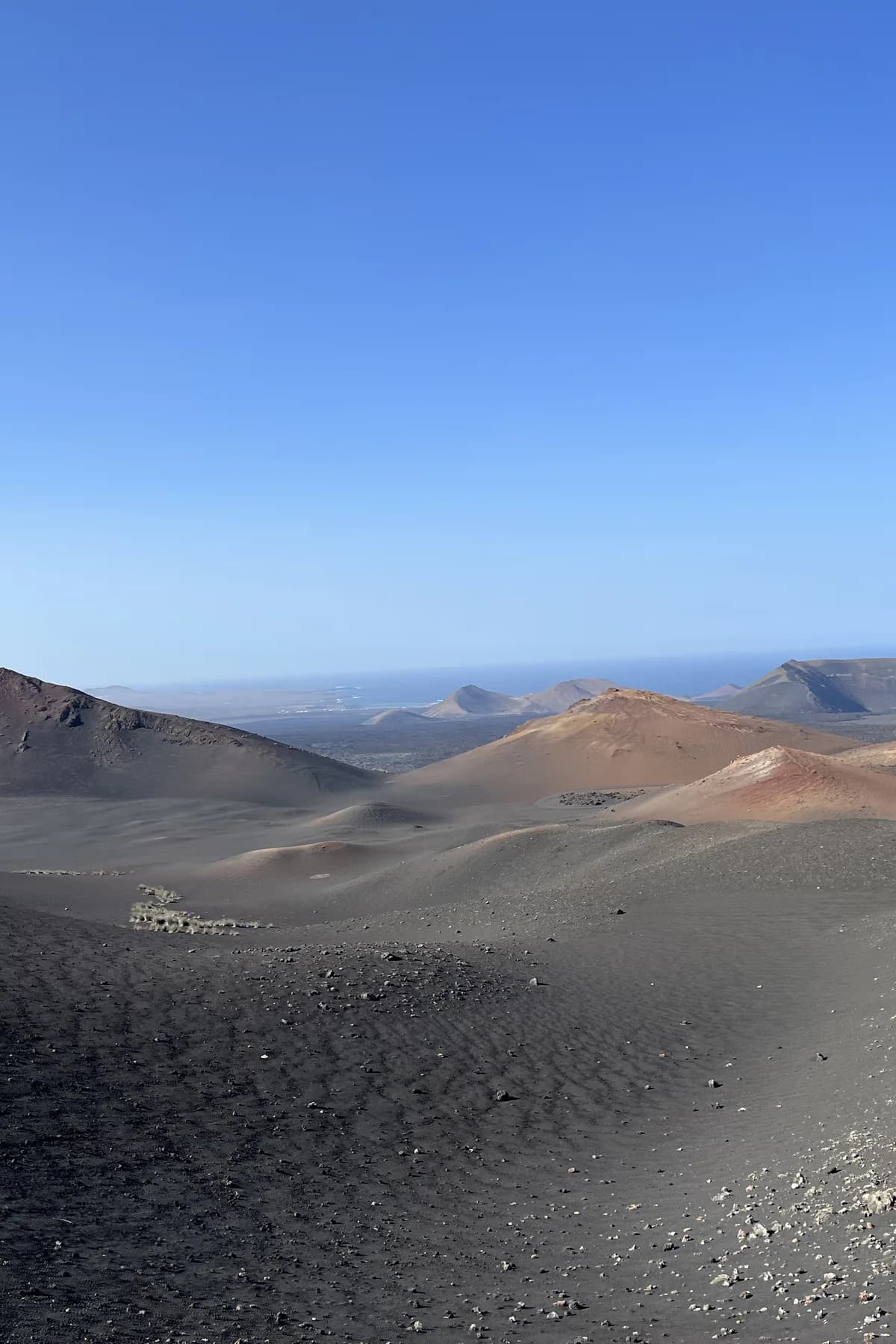
Before flying into space, you have to pass through Lanzarote. That's no joke: the European Space Agency trains its astronauts here in the PANGAEA programme, the school of planetary geology whose students have included names like Luca Parmitano, Pedro Duque and Matthias Maurer. The reason? The island's young lavas, almost free of vegetation and erosion, are the closest thing on Earth to the surface of Mars and the Moon. In its volcanic tunnels, rovers, suits and instruments are tested that will one day work millions of kilometres from here. When you walk through Timanfaya, see it with their eyes: it isn't a strange landscape — it's the dress rehearsal for another planet.
There is a short list of places on Earth where you can genuinely train to set foot on another planet, and Lanzarote holds a place of honour on it. Since 2016, the European Space Agency has held here the campaigns of its PANGAEA programme: an intensive field-geology course designed so that astronauts — used to physics and engineering — learn to read rocks like a planetary scientist. Through its "classrooms" of lava have passed ESA astronauts and collaborators from other agencies: Luca Parmitano, Pedro Duque, Matthias Maurer and more. The final exam is not a written test: it is identifying, describing and sampling volcanic terrain the way they will one day do it on the Moon or on Mars.
Why here, precisely? Because of a combination that is hard to repeat. The eruptions of 1730-1736 and 1824 left young, perfectly preserved lavas: the arid climate has barely eroded them and vegetation has barely colonised them, so the terrain looks today almost as it did on day one — just like the surfaces of Mars, frozen in time. There are basalts comparable to lunar ones, cones and flows of every type and, above all, there are colossal lava tunnels: the Cueva de los Verdes and the La Corona system. That matters because similar volcanic tubes have been detected on the Moon and on Mars, and they are the leading candidates to house the first human bases — natural protection against radiation, stable temperature, a roof of rock. Training in a real tube, here, is the closest you can get to exploring them there.
The campaigns go far beyond the lessons. In the technology-testing editions, the island becomes a proving ground: remote-controlled rovers crossing the malpaís (badlands lava), suits and sampling tools, navigation systems for caves, communication protocols between "astronauts" in the field and scientists in the control room. Scientific institutions from several countries — and collaborations with NASA — have used these lavas to calibrate instruments that search for life on Mars, precisely because here they can study how microbes colonise volcanic rock in extreme conditions.
For the island, this space romance is also a form of recognition: its landscape is so well preserved that it serves as a planetary scientific benchmark. And for you, the visitor, it is a free change of perspective. That endless malpaís you see from the road is not "scorched earth": it is Europe's best Mars simulator, with the advantage of having the sea ten minutes away and chicken roasting over the volcano. The astronauts go home saying the same thing as everyone else: nowhere on Earth did they feel so far from Earth.