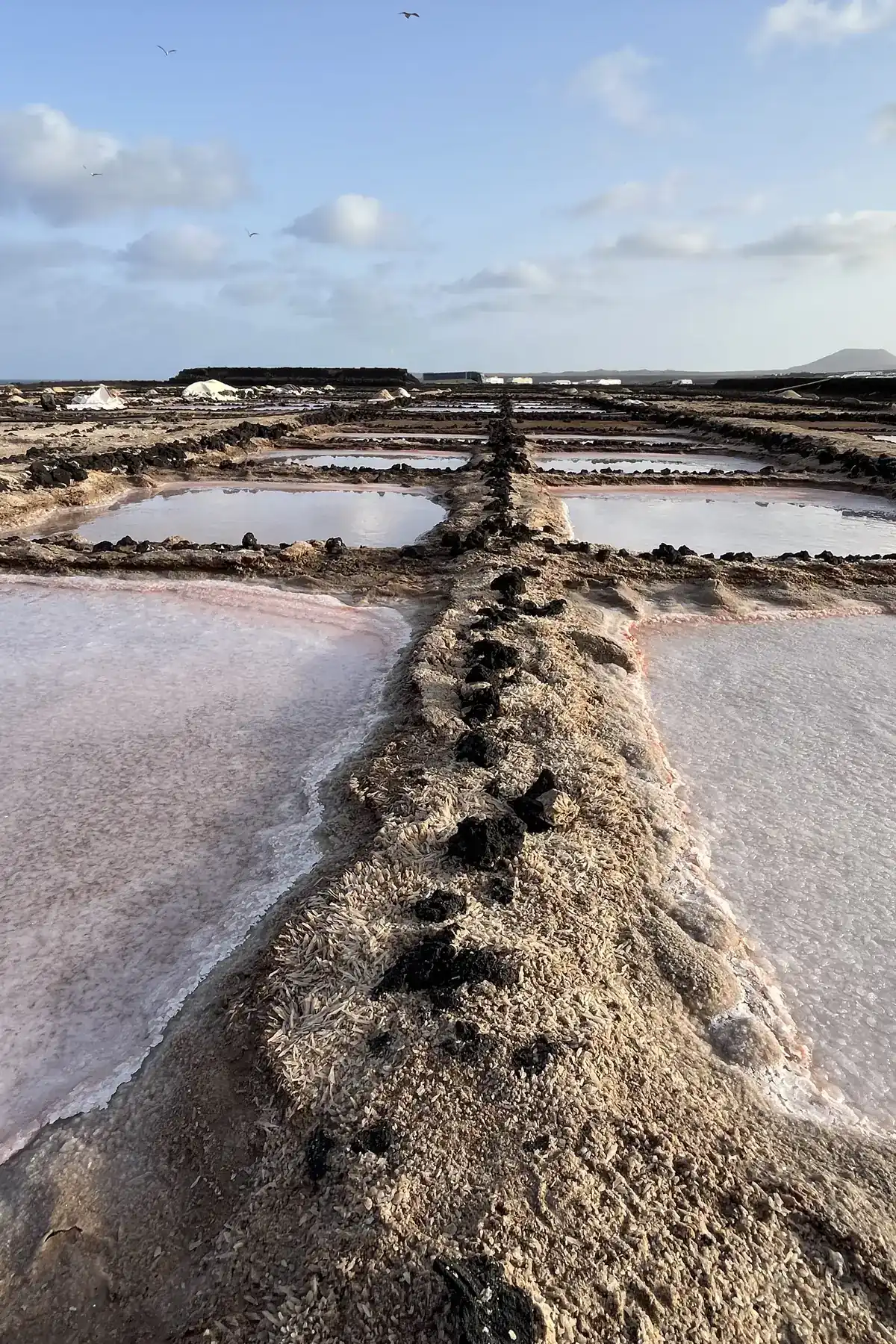
That pink, white and ochre chessboard beside the sea in the south-west is not modern art: it is the Salinas de Janubio, the largest salt pans in the Canaries. Before tourism, salt was the island's oil — without it there was no way to preserve fish, and the fleet working the African grounds depended on these crystals. Janubio came to produce thousands of tonnes a year with a perfect technology: sea, wind, sun and hands. The pink tones are provided by microorganisms that adore extreme salt; the flamingos, on migratory stopover, provide the rest. Today the salt is once again harvested by hand — and Janubio's flor de sal (fleur de sel) travels to the finest kitchens in Spain.
There was a time when this island's wealth was measured in white. Without refrigerators, the only way to preserve fish was salt, and Lanzarote lived from the sea: its fleet worked the African fishing grounds, a stone's throw from here, and every boat loaded tonnes of salt to salt the catch on board. Salt was strategic — like fuel today — and the island, with its fierce sun, constant wind and low coastline, was a perfect natural factory.
The Salinas de Janubio, the largest in the archipelago, were born at the end of the 19th century on a gift from the volcano: the eruptions of 1730 closed off an old bay and turned it into a lagoon — the exact place where the sea could be tamed. The system is a choreography of traditional engineering: the water enters the lagoon, windmills pump it up to the cocederos — broad ponds where the sun gradually concentrates it — and from there it passes to the tajerías, the mosaic of small square beds where it finishes evaporating until it sets into crystal. The salineros (salt workers) then "harvest" the salt by hand, with rakes, and heap it into white pyramids that shine in the sun like miniature icebergs. In its best years, Janubio produced around ten thousand tonnes a year and gave work to hundreds of families.
The colours you photograph have a scientific explanation: in hypersaline waters only extremophile microorganisms survive, and several of them make pink and orange pigments to protect themselves from the sun — the more concentrated the brine, the deeper the pink. The result is that impossible palette: bubblegum-pink ponds beside white ones and indigo mirrors, framed by walls of black stone. The wildlife makes the most of the invention: ringed plovers, black-winged stilts and, in the migration seasons, flamingos stopping over and turning the postcard into an African scene.
The domestic refrigerator pensioned off the white gold in the mid-20th century, and the Canarian salt pans died out one by one. Janubio held on, and today it is living an artisanal and gourmet renaissance: virgin sea salt and a flor de sal — the wafer-fine crystals that set on the surface on perfect days — that chefs fight over. The whole site is protected as a Site of Scientific Interest, it can be visited, and it even has a venerable elder sibling: the small Salinas del Río, at the foot of the Famara cliff, considered the oldest salt pans in the Canaries.
Buy a packet of salt on your way out. It is the island's most honest souvenir: landscape, history and Atlantic Ocean, crystallised together.