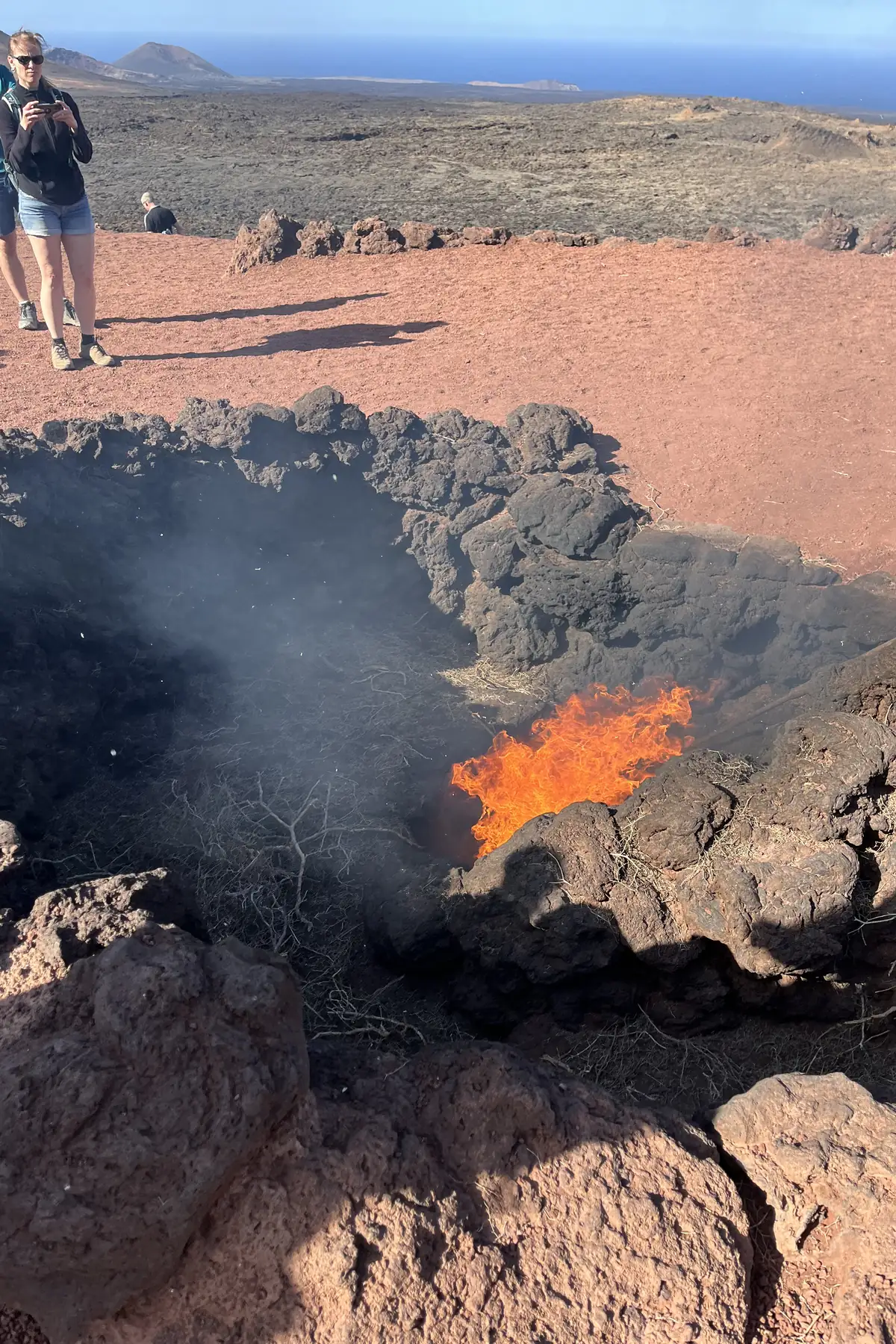
In Timanfaya, the Earth performs magic tricks with no trickery. A guide pours water into a tube sunk into the ground and, seconds later, a geyser of steam roars up into the sky. They toss dry branches into a hole and they catch fire on their own. A few centimetres below the surface, the ground tops 100 °C; at thirteen metres, 600 °C. And here comes the incredible part: the last eruption here ended almost three centuries ago. That heat is the longest goodbye in history — the magma that fed the eruptions of 1730 is still cooling down there, insulated by kilometres of rock. On top of that natural stove, a restaurant designed by César Manrique roasts the chicken. Literally.
The Islote de Hilario, in the very heart of Timanfaya, is the place where more people than anywhere else in the world have — almost — touched the inside of a volcano. The National Park's official figures sound made up: ten centimetres down, the ground hovers around 100-120 °C; at one metre, it climbs; and at about thirteen metres, the sensors read around 600 °C — the temperature of an industrial pizza oven, enough to melt lead. At the surface, however, you can stand there quite calmly: the thin layer of picón (volcanic gravel) insulates like a blanket.
The park's demonstrations are pure science with stagecraft. The dry aulaga (gorse scrub) thrown into a hollow catches fire in seconds, without a single match: it reaches its ignition temperature by simple contact with the ground. The water poured into the tubes sunk into the hillside drops to the hot zone, turns instantly to steam — multiplying its volume more than a thousandfold — and comes blasting out in an artificial geyser that roars like an engine. And in the restaurant El Diablo, designed by César Manrique, the grill is an open pit above the volcano's heat: the chicken roasts over literally geological fire, on one of the most singular barbecues on the planet.
The million-euro question: why is this still so hot, if Timanfaya's eruption ended in 1736? The answer is a lesson in geological patience. Those eruptions left enormous volumes of magma at shallow depth. Rock is a magnificent insulator — the best thermos flask there is — so that magma and the rocks it heated have spent almost three hundred years cooling in slow motion. Groundwater and gases carry part of that heat upwards through particular cracks: the thermal anomalies of the Islote de Hilario. It is not a volcano "about to blow": it is the embers of the bonfire, still glowing red beneath the ash.
And the future? Lanzarote is volcanically active territory — its last eruption was in 1824, that of the volcanoes of Tao, Nuevo del Fuego and Tinguatón — and for that reason it is permanently watched: networks of seismographs, gas sensors and deformation stations monitor every sigh of the subsoil. Scientists see no sign of anything imminent; eruptions give weeks or months of warning symptoms, and here everything has been calm for decades. You can climb the Islote de Hilario with the reassurance of standing on one of the best-monitored volcanoes in Europe.
In the meantime, enjoy the privilege: in very few places in the world does the planet let you rest your hand on its radiator. Here, what's more, it invites you to lunch beside it.