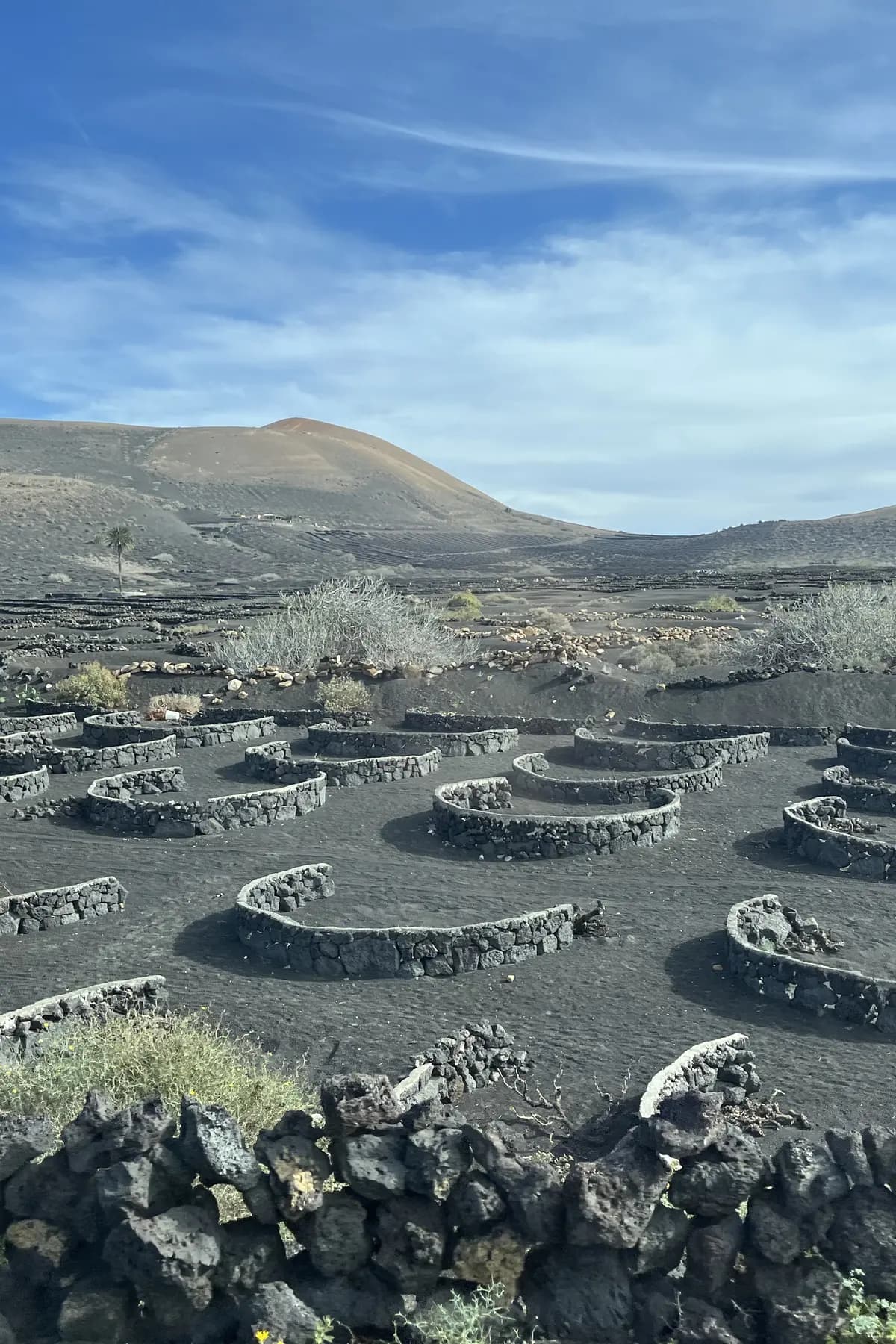
It rains less here than on some edges of the Sahara — and yet the island produces wine, sweet potatoes, lentils, onions and pumpkins. The secret is a peasant technology unique in the world, invented after the eruptions: the enarenados (cinder-mulched fields). The farmers discovered that a layer of volcanic ash works as a sponge for the night dew and a lock on the soil's moisture — and where the volcano hadn't laid it down, they carried it themselves, on camel-back, field by field. Add the zocos (stone windbreaks) — semicircular little stone walls that stop the wind —, the hollows of La Geria and the chains of terraces, and you have a farming landscape so singular that it is studied in universities across half the world. Heroic agriculture, they call it. With good reason.
Let's start with the problem, which is serious: in Arrecife it rains on average little more than a hundred millimetres a year — less than in many parts of the desert — and there is not one river, nor a spring worthy of the name. With that hand of cards, agriculture should be impossible. The answer of Lanzarote's farmers is one of the most ingenious agricultural systems on the planet, born — like so much here — of the catastrophe of 1730.
When the volcano's ash buried the fields, the farmers noticed something unexpected: the plants poking up through the picón (volcanic gravel) grew better than before. The black, porous volcanic grit was doing three jobs at once. At night, its surface cools quickly and condenses the dew — free irrigation from the air. By day, it acts as a lid: it cuts evaporation and keeps the soil's moisture locked beneath it. And all the while, its dark colour warms the earth and its pores let it breathe. The enarenado had been born: farming under a blanket of ash.
Where the volcano hadn't shared out its gift, the farmers delivered it themselves: whole generations digging picón from the roferas (ash quarries), loading it onto camels and carts, and spreading it — handspan by handspan — over the farmland. Think of that when you see a perfect black field: someone built it by hand, layer by layer, like tiling an island. On the enarenados grow today the sweet potatoes, the onions, the lentils and the legendary local potatoes.
The wind, the other enemy, has its own architecture. In La Geria, each vine lives in a hollow dug into the ash, protected besides by a zoco — a semicircular dry-stone windbreak that deflects the trade winds (los alisios). Thousands of hollows and walls draw that landscape of green craters that looks like the work of an artist and is the work of thirst. In El Jable, the farmers sow sweet potatoes and watermelons directly beneath the marine sand, which holds moisture like the picón, defended by windbreaks of stone or rye. And in the valleys of the north, stone terraces climb the hillsides to claw back every drop of runoff.
The whole system works without a single sprinkler: it is absolute dry farming — "heroic agriculture", the agronomists call it — and its landscape is so exceptional that it attracts researchers and has made La Geria protected and celebrated. The best way to honour it is at the table: order local produce — a salad of dry-farmed tomatoes, some lentils, a local wine — and you will be tasting, quite literally, the most elegant victory any farmers ever wrested from a volcano.